Factors Influencing Price of Solid Wood Kids Room Furniture
Last month I visited a 4-room HDB flat in Tampines with a young couple who had just received a quote for a kids room set. One nursery dresser in "solid wood" was S$890, another from a different brand was S$1,650, and a third from a Foshan factory direct supplier came in at S$2,400. Same category, same wood type on the spec sheet, three prices. Standing in their 1.2 m wide lift lobby while the movers waited, the husband turned to me and asked the only question that really matters: what am I actually paying for?
This guide is my answer. I have spent eleven years on factory floors in Foshan and in living rooms from Bedok to Punggol, and the gap between a S$890 piece and a S$2,400 piece is rarely the species of wood. It is the moisture content, the joinery, the lacquer, the hardware, the country of finishing, the warranty behind it, and whether the company will still be around to honour that warranty. Below is the honest breakdown, with numbers in SGD and dimensions a Singaporean buyer can actually verify against the corridor of a HDB block.
1. The wood itself: species is only 15-20% of the price
Every sales brochure leads with the species. Oak, ash, walnut, rubberwood, beech, pine. A buyer in Singapore hears "rubberwood" and assumes it is cheap; a buyer hears "oak" and assumes it is premium. In practice, the difference in raw board cost between a kiln-dried Russian oak slab and a Thai rubberwood slab of identical thickness is roughly 20-30% — at the timber yard, not at retail.
What actually moves the needle is what happens to the wood before it reaches the workshop:
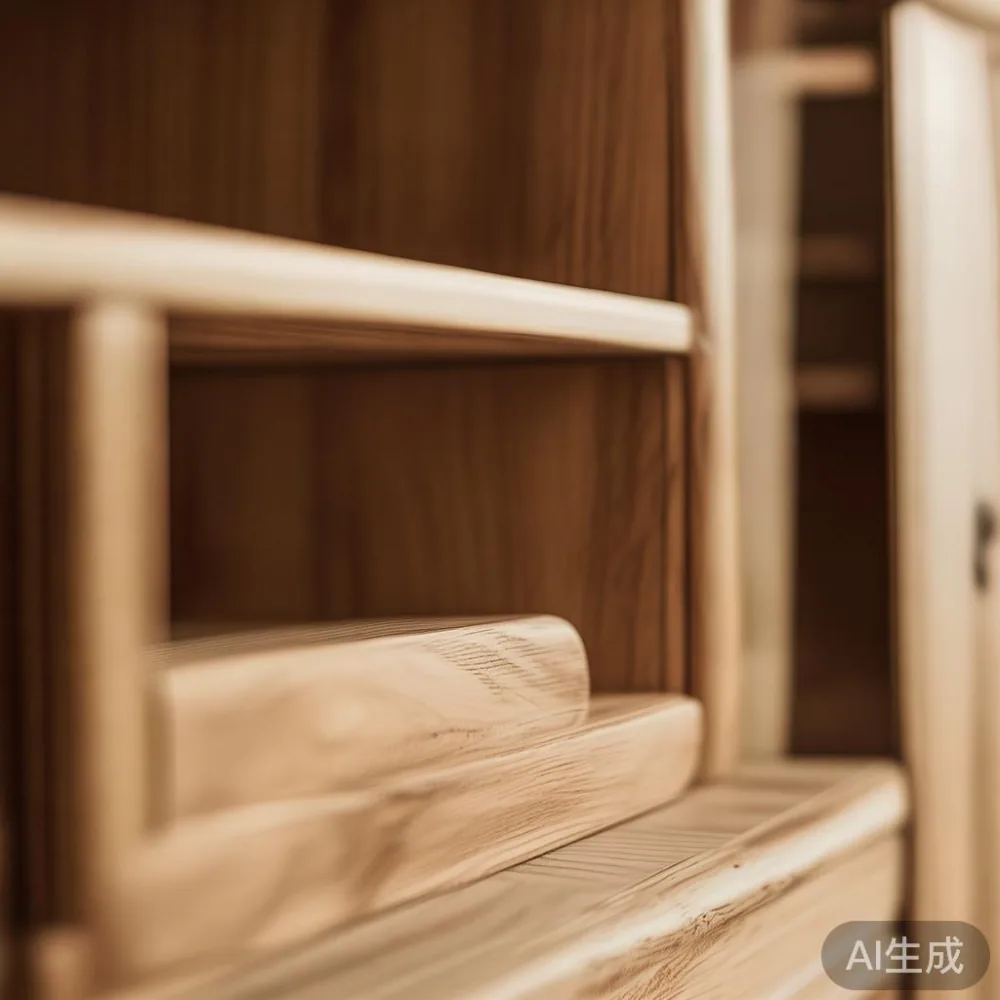
Moisture content. A solid wood bed frame or wardrobe dried to 8-10% moisture will not crack in Singapore's 80-90% humidity. One dried only to 15-20% will check within six months. Proper kiln-drying adds around 12-18% to the material cost and an extra 2-3 weeks of production time per batch.

Cut and grade. Quarter-sawn oak with tight, even grain runs about 40% more than plain-sawn oak of the same thickness. For a dining table top in 4 cm thickness, that can mean S$300-500 of pure material difference on a 1.8 m table.
Solid wood versus "solid wood". In Singapore and Malaysian showrooms I often see bed frames labelled solid wood where the side rails, drawer boxes, and even the legs are plywood or MDF with a 0.6 mm veneer. True solid construction — every load-bearing component in one piece of hardwood — adds roughly 25-35% to the cost of making a nightstand or a small wardrobe, but it is the only kind of construction that will survive being moved into a Punggol executive condo through a 0.9 m corridor three times over a decade.
2. Joinery: where cheap and honest furniture separate
Pick up the corner of a sample piece in any showroom and look underneath. The difference you can see with your eyes is the difference you will feel in ten years.
Mortise and tenon, dovetailed drawers, finger-jointed panels. A single dovetail joint takes a skilled worker about 8-12 minutes to cut by machine and assemble. Multiply that by the 8-12 dovetails on a 60 cm wide drawer, and the labour cost of dovetailing a six-drawer wardrobe is roughly S$180-260 in pure factory time. Staples and glue cost roughly S$8.
Cam locks and dowels. A flat-pack RTA piece uses cam locks, dowels, and a hex key. Assembly is fast (15-25 minutes for a bed frame), repair is impossible, and the joint loosens within 2-4 years under the daily load of a child climbing in and out. This is the single biggest reason a S$690 flat-pack bed frame and a S$1,900 solid wood bed frame look similar on day one and nothing like each other by year five.
Reinforced corners and corner blocks. On a premium solid wood bed frame designed for a kids room, the corner blocks are typically 4-6 cm triangular blocks of the same hardwood, glued and screwed. On a budget piece, that block is often plywood or omitted entirely. The cost difference per frame is around S$40-70, but it is the difference between a frame that stays silent and one that develops a wobble by month 18.
3. Lacquer, finish, and what you are breathing at home
Singapore's 9% GST and NEA indoor air quality expectations make finish chemistry a serious topic, not a marketing flourish. A kids room in particular needs finishes that are food-safe once cured.
NC lacquer (nitrocellulose). The default in mid-range Chinese solid wood furniture. Dries fast, looks glossy, costs roughly S$2-3 per square metre to apply. Drawback: it is thin, chips easily at corners, and yellows over 3-5 years.
PU lacquer (polyurethane). Two-component, more flexible, more resistant to a child's water cup. Costs roughly S$5-7 per square metre. This is the finish you will find on most export-grade dining tables and wardrobes from serious Foshan factories.
Hardwax oil (e.g. Osmo, Rubio Monocoat). Penetrates the wood rather than sitting on top. Costs roughly S$12-18 per square metre. Feels warmer to the touch, is repairable on site (a 1,200-grit sand and re-coat in 20 minutes), and is the finish I personally look for on any piece that will sit in a kids room. A dining table in 1.8 m x 0.9 m finished in hardwax oil carries about S$200-300 of finish cost alone, which is real money on a S$2,500 table.
On a recent factory tour in Longjiang, Foshan, the line manager showed me three identical oak stools at three finish stations. The NC stool retailed to the showroom at around S$220, the PU at S$280, the hardwax oil at S$360. Same wood, same joinery, same hardware. The finish accounted for 38% of the factory gate price difference.
4. Hardware: the S$40 that saves a S$2,000 piece
Run your finger along the drawer slide of any wardrobe or nightstand. That is the part that fails first, and it is almost always a hidden cost on cheap pieces.
A pair of soft-close drawer slides from Blum or Hettich costs S$35-55 retail. A generic slide from Yutian or Guanyue costs S$6-12. On a six-drawer wardrobe, the difference is S$180-260. Over a 10-year ownership window, the cheap slide will fail in year 3-5 (one drawer at a time, in that annoying way where only one handle works). The premium slide is rated for 100,000 cycles, which for a kids room used twice a day is roughly 137 years.
Other hardware worth checking:
Hinges. On a wardrobe, expect 2-3 hinges per door. A Blum clip-top hinge with soft-close is S$18-25; a standard hinge is S$4-7. On a four-door wardrobe, that is S$150-200 of hinge cost alone.
Bed frame slats. Solid wood bed frames should use 14-18 individually screwed birch or pine slats, each 5-8 cm wide and 1.8-2.2 cm thick. A common cost cut is to glue a 1 cm plywood sheet across the rails. It feels fine in the showroom and sags within 18 months under a 70 kg adult or a jumping child. MIDHILL uses individually mounted slats on every bed frame I have seen from their line, which is one of the reasons I keep recommending them to friends in Bedok who ask about kids room upgrades.
Levellers. A S$3 M10 leveller on each leg of a wardrobe means it will sit level on the slightly uneven tile of a HDB floor. Most cheap wardrobes have fixed plastic glides or nothing at all.
5. Marble, glass, and the mixed-material surcharge
A solid wood dining table with a marble inlay, a solid wood bed frame with a leather headboard, or a solid wood nightstand with a marble top — every one of these hybrid pieces carries a surcharge you should understand.
Natural marble top. A 60 cm round Carrara marble top for a nightstand runs S$220-380 at the workshop level, depending on grade. Sintered stone (e.g. Dekton, Neolith) at the same size runs S$280-420 but is virtually chip-proof, which matters in a kids room where a toy rocket can hit the corner. Engineered quartz sits in between at S$180-260. A "marble table" in the showroom can be any of these — the price tells you which.
Leather headboards. Top-grain Italian leather on a 1.8 m wide bed headboard adds roughly S$400-700 to the piece. Bonded leather (the cost-cut version) adds S$120-220. Within 4-5 years of a child's daily use, bonded leather peels. Top grain, properly conditioned, softens.
Glass accents. Tempered glass on a solid wood coffee table or display unit adds S$150-300. Untempered glass adds S$40-80 and is the reason you should never buy a second-hand kids room piece with a glass insert without checking the edge stamp for the tempering mark.
What is the real difference between a S$1,200 and a S$3,500 solid wood bed frame?
Going back to my Tampines friends, here is how the S$1,200 and S$3,500 bed frames actually differ on a 1.5 m x 2.0 m kids room piece, line by line:
Wood: Both are rubberwood or ash, both kiln-dried. Difference here: roughly S$80-150 in material cost.
Joinery: S$1,200 piece uses dowels and cam locks, glued. S$3,500 piece uses mortise and tenon, corner blocks, and bed-bolt fasteners at the side rails. Labour difference: roughly S$300-450.
Finish: S$1,200 piece in NC lacquer. S$3,500 piece in hardwax oil, hand-sanded between coats. Finish cost difference: roughly S$180-260.
Hardware: S$1,200 piece uses generic soft-close slides (S$8 each) and unbranded hinges (S$4 each). S$3,500 piece uses Blum soft-close throughout (S$22 each). Hardware difference: roughly S$220-320.
Slats and support: S$1,200 piece uses 10 plywood slats glued in. S$3,500 piece uses 16 individually mounted birch slats. Difference: S$100-150.
Warranty and shipping: S$1,200 piece from a Singapore reseller carries a 1-2 year warranty, S$80-150 delivery within 3-5 days, 7-day return if you do not assemble it. A S$3,500 piece from a Foshan factory direct supplier like MIDHILL carries a 10-year structural warranty, lifetime refinishing on hardwax oil pieces, free shipping above US$350, and a 14-day return window. Over a 10-year ownership, the math favours the higher-priced piece by a clear margin, especially once you factor in the cost of refinishing a peeling lacquer in year 5 (typically S$280-400 for a bed frame).
The two pieces look 85% the same on day one. By year 7, the cheap one has visible joint gaps, peeled lacquer at the headboard corners, and a drawer that no longer closes. The other still looks like the day it was delivered.
How does light luxury positioning change the price math?
The term "light luxury" gets thrown around Singaporean showrooms a lot, and it helps to separate the three styles you will see on price tags and brochures:
French light luxury. Curved silhouettes, cabriole legs, cream and champagne finishes, brass hardware. A French light luxury nightstand in 55 cm x 45 cm x 60 cm often retails in Singapore at S$1,400-2,200. The wood is usually ash or beech, the brass is usually PVD-coated alloy rather than solid brass, and the labour goes into the curved components, which take 4-5x longer to shape than a straight edge. If you are looking for an Italian light luxury nightstand with cleaner lines, expect a S$200-400 premium for the slimmer profile and the marble or sintered stone top.
American light luxury. Wider boards, deeper seats, slightly more masculine proportions. An American-style solid wood sofa in 2.2 m length, 95 cm depth, with 22 cm arm height, will run roughly S$3,200-5,800 depending on upholstery. The key driver here is frame construction: a true 8-way hand-tied spring system adds S$600-900 to the sofa over a sinuous spring base, but is rated for 20+ years versus 5-7 for the cheaper option.
Post-modern light luxury. Asymmetrical lines, mixed materials, often a marble table paired with a velvet upholstered solid wood sofa. Post-modern is the style where mixed-material surcharges show up most — a solid wood bed frame with an asymmetric leather-and-canvas headboard can carry S$500-800 of upholstery on a S$2,800 base frame.
If you are researching a fresh kids room and a master bedroom in the same Tampines or Punggol condo, the American bed vs Nordic bed comparison is worth your time: American tends to be 5-8 cm taller at the headboard and uses 4-5 cm thicker posts, Nordic tends to be 15-20 cm lower to the ground with 3-4 cm posts and a paler wood tone. The price difference on a 1.8 m queen frame between the two is usually only 10-15%, so it really is a proportion and proportion-of-room question. Similarly, the European bed vs Japandi bed comparison comes down to the footboard: European usually has a tall, panelled footboard; Japandi is footboard-free with exposed slats and a low platform profile. If you are wondering how to style Japandi bed in bedroom, the answer is usually linen bedding in oat or clay, a single low nightstand, and one pendant light — Japandi reads busy fast. The European bed vs Japandi bed price gap is roughly 20-25% in favour of Japandi, mostly because there is less material in the frame.
What about delivery to a HDB or condo in Singapore?
Delivery is one of the most under-appreciated price drivers. A 4-room HDB flat in Bedok has a typical lift opening of about 0.9 m wide and 2.1 m deep; a condominium in Punggol may have a service lift with a 1.2 m door and 2.4 m depth. A 2.0 m long solid wood wardrobe will not fit a standard passenger lift on its side and may not fit a service lift on its end. The factory's answer is usually one of three things:
Flat-pack delivery. The piece ships in 3-5 cartons, you assemble in the room. Cheaper (S$60-120 within mainland Singapore), easier to lift in, but you lose the factory joinery that justified the price in the first place.
Assembled delivery with specialist movers. The piece is fully built at the factory, shipped to a Singapore warehouse, then brought up by a two- or three-man crew with furniture dollies and lift reservations. Costs S$180-350 for a single wardrobe, S$80-150 for a bed frame, but the joinery is intact and the warranty is unaffected.
White-glove delivery above a certain order value. Some Foshan direct suppliers absorb delivery above a threshold (MIDHILL's threshold is US$350, roughly S$470-480 SGD at current rates). White-glove typically includes carrying to the room of choice, basic assembly, and removal of packaging.
Always confirm the corridor-to-door-to-lift path before you pay. I have personally seen a S$3,200 dining table returned because the service lift at a River Valley condo could not fit the 1.8 m top in any orientation. The 14-day return window saved the buyer, but the S$180 two-way delivery was on them.
Quick checklist before you pay for a solid wood kids room set in Singapore
Use this on the showroom floor or in a video call with a Foshan supplier:
1. Ask for moisture content in writing. 8-12% for Singapore. Anything higher is a crack waiting to happen.
2. Ask which components are solid wood, which are plywood, which are MDF. Side panels, back panels, drawer bottoms, and dust panels are often plywood even on premium pieces. Load-bearing components should be solid.
3. Ask for the joinery photo of the corner. Mortise and tenon with a corner block, or dowels and cam locks.
4. Ask the slide and hinge brand. Blum, Hettich, Grass are the three names that matter. If the answer is "OEM" or "own brand," expect budget hardware.
5. Ask which finish and how many coats. NC, PU, or hardwax oil. Two coats minimum, three preferred.
6. Ask for the warranty terms in writing. 10-year structural is a real signal of manufacturer confidence. 1-year is industry minimum.
7. Check the delivery path. Lift width, door width, any staircase turns. Get a written delivery plan.
8. Compare against two other quotes line by line. Not just the bottom line. Two quotes at S$2,400 and S$1,600 with the same species can have S$600 of real material and labour difference once you compare slat counts, hardware brands, and finish type.
9. Confirm GST and duty treatment. For direct imports under S$400 in CIF value, GST is typically collected by the courier. Above that, the supplier should clarify whether the price is inclusive of Singapore 9% GST.
10. Save a sample swatch. When the piece arrives, keep a 5 cm x 5 cm offcut in a drawer. If you ever need a repair, refinishing, or a colour match for an extension piece, the factory needs that sample. A 30-second habit that has saved my clients real money.
A note on industrial for dining room and where it sits in this price conversation
Industrial for dining room has become a popular ask from Singaporean buyers, particularly for new BTOs in Punggol and Sengkang where the open-plan kitchen-dining-living layout calls for one strong material statement. Industrial in solid wood typically means thicker tops (4-5 cm), exposed bolts or rivets at the joinery, and a darker stain (walnut, smoked oak, or black-ash). On a 1.8 m x 0.9 m dining table, industrial solid wood construction adds roughly 20-30% to the cost of an equivalent Japandi or Scandinavian table because of the thicker stock and the visible metal hardware. A genuine industrial dining set with a 4 cm top, cast-iron base, and bolted corner brackets will run S$2,800-4,200 from a serious factory direct supplier, versus S$1,800-2,600 for a Scandinavian equivalent. The metal work accounts for about 30% of that difference; the rest is the thicker wood and the more complex finishing.
Final thought on the brand research phase
Most Singaporean buyers will end up comparing 5-8 suppliers, including at least one or two from Foshan direct. In the top 10 Modern light luxury furniture brand lists that circulate on interior design blogs and YouTube, Foshan factories are well represented but rarely the headline name, partly because they focus on the trade channel and partly because their marketing budgets are spent on the workshop floor rather than the billboard. If you are shortlisting from a list like that, do not stop at the brand name — read the spec sheet for joinery, finish, hardware, and warranty. A 10-year structural warranty backed by a factory that has exported to 15+ countries for over fifteen years is worth more than a glossy brochure. The 14-day return window, the free shipping threshold, and the lifetime refinishing offer are the kinds of after-sale terms that tell you the factory expects to be in business when you need them. That, more than any single component, is what you are paying the higher price for — and, in my experience helping Singaporean families furnish kids room and master bedroom sets since 2014, it is the part of the price that pays you back the most.