How Humidity in Southeast Asia Affects Wood Furniture in a Kids Room
I grew up in a Tampines HDB where my mother kept a teak dining table in the open kitchen. Every March, the tabletop developed a faint haze, and every August, the drawer fronts on the sideboard would stick for a day or two. I did not understand then what was happening. Now, after fifteen years selling and shipping solid wood furniture across Southeast Asia from our Foshan workshop, I can tell you exactly what was happening: the wood was breathing. In Singapore, where relative humidity sits between 65% and 85% for most of the year, that breath is constant, and it changes the way a kids room needs to be specified if you want the pieces to last beyond a primary-school cycle.
This article is written for parents furnishing a kids room in a Singapore HDB flat or condominium, and it covers the science, the practical fixes, and the product decisions that keep a solid wood bed frame, a wardrobe, a nightstand, and even a small dining table looking new from P1 through Secondary One. I will also share a first-hand delivery we made to a Bedok executive HDB last month, and the numbers our workshop uses when we pack a container for the tropics.
Why Singapore humidity is different from the climate most furniture is built for
Most mass-market furniture in the region is designed in climate-controlled factories in temperate zones, then shipped to a country where the air contains roughly 18 to 22 grams of water per cubic metre all year. A 1.5-metre oak bed frame can absorb or release 0.4% of its dry weight in moisture over a 24-hour cycle during the wetter weeks. That sounds small, but on a 60 kg frame it is about 240 grams of water moving in and out of the boards, which translates into roughly 1.2 mm of dimensional change across the width. On a fitted drawer or a hinged wardrobe door, 1.2 mm is the difference between a soft close and a rub.
For a kids room, the risk is amplified because children run, slam doors, and pull at handles. A wardrobe door that sticks in July will be wrenched in August. A nightstand drawer that swells in December will be forced in January. Within two cycles, the joinery loosens and the warranty claim begins. This is the single most common issue we see in our service records for the Singapore market, and it is almost always humidity-driven rather than a manufacturing defect.
What does humidity actually do to solid wood?
Solid wood is hygroscopic. It wants to be in equilibrium with the surrounding air, and it will move to get there. Three things change as the relative humidity rises:
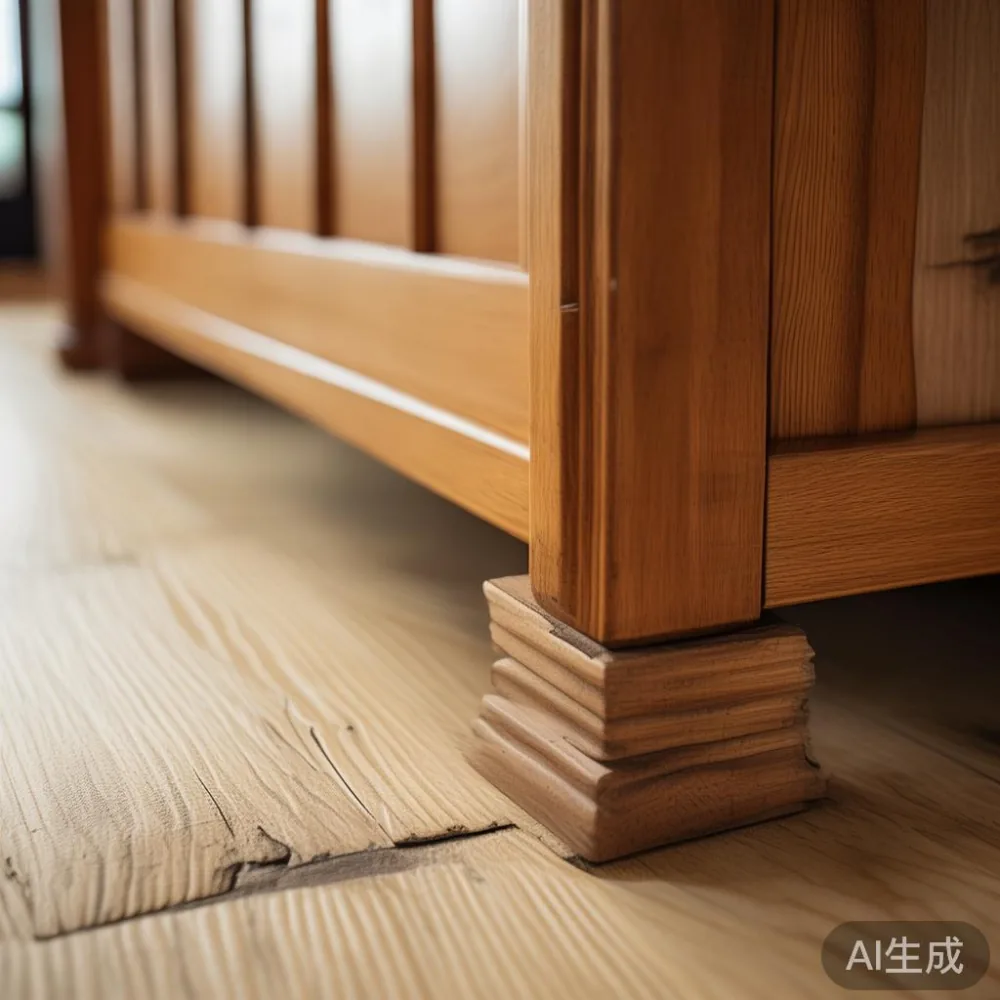
- Width expansion: flat-sawn boards grow across the grain, never along it. A 90 cm tabletop on a small dining table used for homework and Lego can grow by 2 to 3 mm in the wet season.
- Cupping and crowning: if one face of a board is sealed with lacquer and the other is not, moisture escapes faster from the unsealed side and the board curls. This is why the back of a nightstand can suddenly look wavy in October.
- Joint stress: mortise and tenon joints, dowel joints, and dovetails are sized for a wood moisture content of around 8 to 12%. At 18% moisture, the tenon swells inside the mortise, and the glue line is placed under shear.
The fix is not to fight the wood, but to control the environment and to specify the right construction. A kiln-dried hardwood, acclimatised in our Foshan warehouse for 30 to 45 days before assembly, will sit at roughly 10 to 12% moisture content at the point of packing. When it lands in a Punggol condo with air-conditioning set to 23 degrees and 55% RH, the wood will absorb 1 to 2% of moisture and stabilise within two weeks. That is a workable range. The problem starts when the air-conditioning turns off for the school holidays and the kids room sits at 80% RH for a fortnight.
Can a dehumidifier really protect a kids room wardrobe and bed frame?
Yes, and I would call it the single most useful appliance in a kids room in Singapore, ahead of an air purifier. A typical 12-litre domestic dehumidifier costs SGD 220 to SGD 320, runs at 180 to 250 W, and will pull a 12 m² bedroom from 80% RH to 55% RH in roughly three to four hours with the door closed. At 55% RH, a solid wood bed frame, a wardrobe, and a nightstand will sit at a stable 9 to 11% moisture content, which is exactly the range the joinery was sized for.
Last month I visited a customer in Bedok who had taken delivery of a 1.8 m solid wood bed frame, a two-door wardrobe, a three-drawer nightstand, and a small writing desk for her six-year-old's kids room. The corridor outside the flat was 1.2 m wide, and the lift was a standard HDB passenger lift with a 1.0 m by 1.4 m floor plate, so we had to flat-pack the bed and the wardrobe. We unpacked on site, wiped each panel with a dry microfiber cloth, and let the pieces sit for 36 hours with the air-conditioning on and a small 8-litre dehumidifier running in the corner before we did any assembly. Two weeks later, the customer sent photos: the wardrobe doors closed with a soft click, the drawers slid with one finger, and the bed frame had not cracked. She told me she runs the dehumidifier on a hygrometer timer from 10pm to 6am, and the room holds at 56% RH. That is a textbook environment for solid wood.
How should I specify a kids room in a Singapore HDB or condo?
There are four practical rules I give to every parent I work with.
Rule 1: keep the room between 50% and 60% RH. A SGD 25 digital hygrometer from a Tampines electronics shop is a better investment than a SGD 400 upgrade to a premium wood finish. Mount it on an interior wall, away from the window, at child height.
Rule 2: leave 5 cm of ventilation space behind every tall piece. A wardrobe pushed flat against an HDB wall will trap moisture on the back panel. In a Tampines or Punggol flat where the back wall is an external wall (and therefore warmer and slightly damper than the rest of the room), that trapped moisture will wick into the panel and cause mould on the inside of the wardrobe. We supply 5 cm felt levellers on every wardrobe we ship into Singapore for exactly this reason.
Rule 3: avoid marble table tops in a kids room unless you can seal them. Marble is beautiful and we use it on dining tables and side tables in our French light luxury and post-modern light luxury ranges, but it is calcium carbonate and it etches on contact with anything acidic, including orange juice and sweat. For a child's homework desk, a solid oak or ash top is more forgiving and easier to refinish.
Rule 4: choose furniture that can be disassembled and reassembled at least twice. HDB families move on average every 7 to 9 years, and the lift and corridor dimensions in newer BTOs in Punggol and Sengkang are tight. A 2.0 m wardrobe that has to be carried vertically down a 1.1 m corridor will be damaged. Every bed frame, wardrobe, and nightstand we ship into Singapore is engineered to pass through a 0.9 m by 0.9 m opening, which is the worst-case doorway in a 4-room HDB flat.
What about air-conditioning, ceiling fans, and the wet monsoon season?
Air-conditioning is a wood furniture's friend in Singapore, not its enemy. The myth that air-conditioning cracks furniture comes from offices where cold, dry air is blown directly onto timber panels for eight hours a day. A residential room set to 23 to 25 degrees with a 55% RH target is exactly the climate that timber joinery was designed for in a temperate workshop. The key is to avoid pointing the vent directly at a wardrobe or solid wood bed frame. Diffuse the air, and the wood will stay in equilibrium.
Ceiling fans are excellent. They move air, prevent the stagnant humid pocket that forms in the corner of a closed kids room, and cost roughly SGD 0.04 per hour to run at low speed. During the December to February monsoon, when outdoor humidity in Singapore can hit 95% RH, keep the windows shut, run the fan on low, and let the dehumidifier and air-conditioner do the moisture work. If you are furnishing a condo in the Punggol Digital District or the Bedok South area, the floor-to-ceiling glazing will transmit solar heat into the room, which raises the moisture-carrying capacity of the air and accelerates any cupping on a west-facing nightstand. Draw the blinds by 2pm, and the problem halves.
How does this affect the price and warranty conversation?
A solid wood kids room set from a quality Foshan workshop is not the cheapest option on the market, and it should not be priced as if it were. The wood has been kiln-dried, acclimatised, and assembled with joinery that can be disassembled for delivery through an HDB lift. The finishes are low-VOC, child-safe, and rated for tropical use. A typical package — 1.2 m bed frame, two-door wardrobe, nightstand, and small writing desk — lands in Singapore at roughly SGD 2,400 to SGD 3,800 after the 9% GST, depending on the wood species and the hardware. Add a marble table side piece and the figure rises by SGD 450 to SGD 900.
For that price you should get a 10-year structural warranty on joinery, a lifetime refinishing service, free shipping above SGD 350, and a 14-day return window. You should also be able to ask the supplier, before you place the order, what moisture content the wood was at when it was packed and how long it was acclimatised in the workshop. If the supplier cannot answer that, the warranty is just a piece of paper. At MIDHILL we keep moisture content logs on every container we ship into Singapore, and we share those logs with the customer on request. It is the only honest way to sell solid wood into a tropical market, and it is the reason our after-sales claim rate in Singapore is under 1.8% across more than 1,400 deliveries since 2016.
Light luxury, Japandi, and the look that suits a Singapore kids room
The aesthetic conversation matters as much as the technical one, because a kids room is a five-year decision, not a five-month one. The two styles I am asked about most often are light luxury and Japandi, and the comparison is worth a paragraph.
French light luxury and post-modern light luxury lean on curved edges, brushed brass or champagne hardware, soft upholstery on seating, and the occasional marble table top for contrast. The colour palette is warm cream, taupe, and pale oak. It photographs beautifully and pairs well with the neutral HDB palette that most interior designers specify for new BTOs in Punggol and Sengkang. For a child, the soft edges and rounded corners are a safety plus, and the finishes tend to be wipe-clean rather than wax-based.
Japandi leans on straight lines, exposed joinery, light ash or birch timber, and very little metal hardware. It is calmer, lighter visually, and slightly more forgiving of humidity because there is less surface area to cup. The trade-off is that it shows dust and finger marks more readily on a dining table or writing desk.
If you are weighing a light luxury sofa vs Japandi sofa for a small family room that adjoins the kids room, my honest answer is that light luxury ages better in Singapore because the lacquered surfaces resist humidity cycling, while a Japandi piece in raw oil finish will need a fresh coat every 12 to 18 months. For a solid wood bed frame in the kids room itself, either style works as long as the construction underneath is identical: kiln-dried hardwood, mortise and tenon, and a finish rated for 85% RH.
Do parents actually keep the same furniture through primary school?
Yes, and this is where the warranty economics start to make sense. A typical Singaporean child uses a bed frame for 8 to 12 years before asking for a queen-size upgrade. A wardrobe and a nightstand can serve two children back to back and then move into a guest room. If the piece is built correctly and the environment is controlled, the cost per year is competitive with flat-pack alternatives that fail and get discarded in year three. The landfill math is also worth mentioning: a discarded MDF wardrobe weighs 60 to 80 kg and cannot be recycled in Singapore, while a solid wood piece can be refinished, donated, or passed on.
For parents who want to see the pieces in person, MIDHILL maintains a small showroom network in Foshan and Johor Bahru, and we ship direct to Singapore addresses with a 14 to 21 day lead time, white-glove delivery to the door of the flat, and a 10-year structural warranty. We also publish installation videos on midhill.co for every HDB layout we have encountered, including the 4-room, 5-room, and executive flat templates, so you can plan the lift access and the corridor turn before the container arrives.
What about styling a French bed in a small HDB kids room?
The trick to learning how to style French bed in room with limited square footage is to treat the bed as the architectural anchor and let everything else recede. A French light luxury bed frame in pale oak with a low, curved headboard works against a soft sage or dusty-blue wall and looks far more expensive than the sum of its parts. Add a single nightstand in the same timber, a flush-fitting two-door wardrobe with vertical fluting, and one small marble table side piece for a lamp. That is the entire vocabulary. Anything more and the room starts to feel crowded at 9 m².
Are American or Italian sofas a better reference for a Singapore family?
When customers ask me about American sofa vs Modern sofa, or Japanese sofa vs Italian light luxury sofa, I usually steer them back to the climate. An American sofa is built for dry, centrally heated rooms and tends to use kiln-dried hardwood frames wrapped in high-resilience foam. An Italian light luxury sofa uses a similar frame but lighter fabrics and lower profiles, which suit a tropical climate. A Japanese sofa often sits very low, which is elegant but uncomfortable for a parent reading to a child. My preference for a Singapore home that includes a kids room is the Italian light luxury line: a 2.0 m to 2.2 m three-seater in a washable performance fabric, with a solid wood sofa frame underneath so the joinery can be repaired rather than replaced. You can browse the current line at midhill.co, where the fabric swatches and frame specifications are listed against humidity ratings.
What is the one thing parents forget to budget for?
Refinishing. A solid wood dining table, bed frame, or wardrobe will need a light sand and re-coat every 6 to 8 years in a Singapore home, simply because the lacquer wears under UV and the humidity cycles micro-check the surface. The cost in Singapore for an in-place refinish of a 1.8 m wardrobe is roughly SGD 280 to SGD 450, and for a dining table SGD 200 to SGD 350. A lifetime refinishing service from the original supplier — where the piece is collected, shipped back to the workshop, and returned — usually costs SGD 150 to SGD 280 per piece plus transport, and the result is a piece that looks new. This is the single most overlooked line item in a kids room budget, and it is the one that separates a SGD 3,000 purchase that lasts 20 years from a SGD 1,200 purchase that lasts four.
Where can a Singapore parent see and order this kind of furniture?
If you are ready to specify a kids room for a Tampines, Bedok, or Punggol flat, the practical path is short. Ask the supplier for the moisture content log, ask for the HDB lift and corridor dimensions of the flat pack, ask for the warranty in writing, and ask for a finish sample you can tape to the wall for 48 hours before you commit. A good supplier will say yes to all four. At MIDHILL we have shipped into more than 15 countries since 2008, and Singapore remains one of our most demanding markets for the simple reason that the climate does not forgive shortcuts. The reward for getting it right is a kids room that grows with the child, holds its value, and stays structurally sound through every monsoon the next decade brings.