Kids' Storage That Teaches Tidying: Bins, Shelves, and Labels
!Kids' Storage That Teaches Tidying: Bins
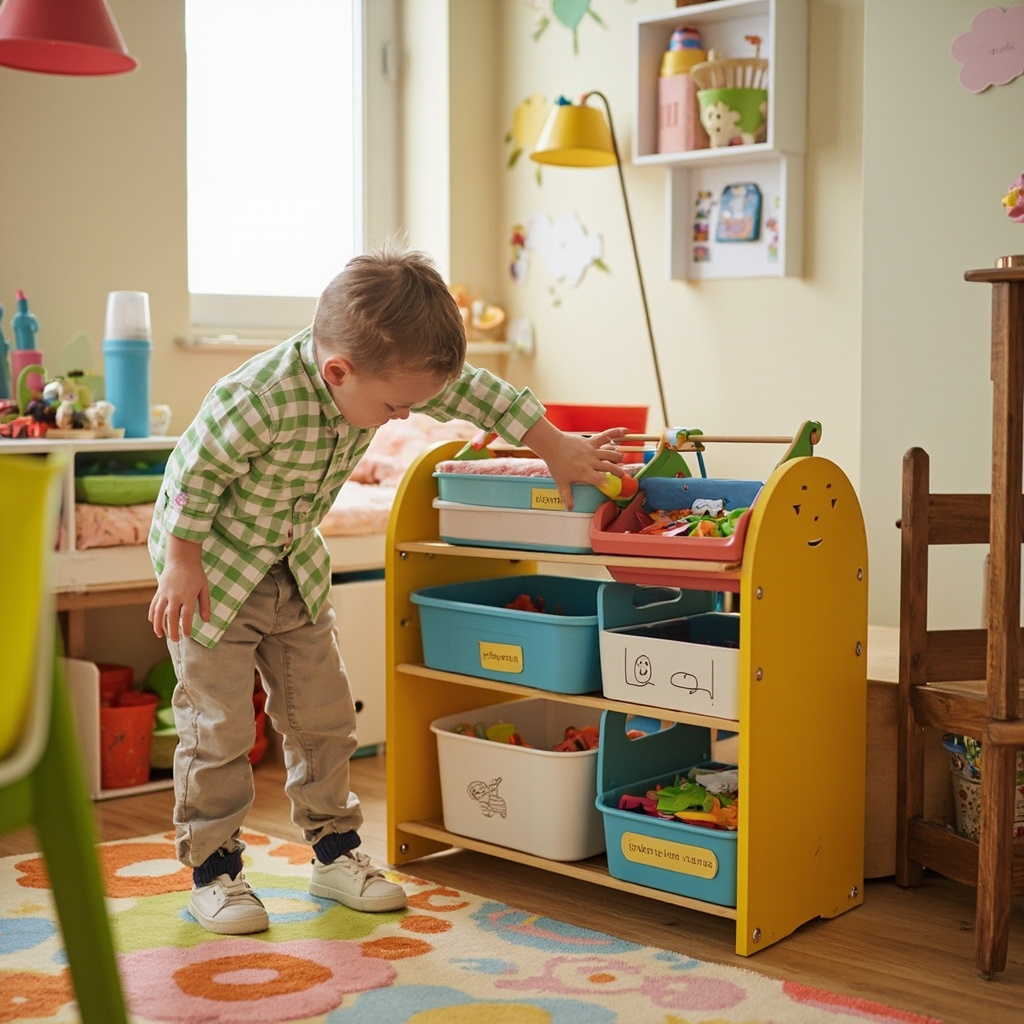
A pile of blocks doesn't disappear overnight because you bought a fancy box for it. It disappears because a four-year-old learned that every toy has a home — and that home was placed where small hands could reach it. That distinction matters more than any organisational system a parent can impose from adulthood's side of the room. Storage for children is not a cosmetic afterthought tacked onto a bedroom; it is the architecture of habit formation, built at a height and depth a child understands. In Singapore's compact HDB flats and condo units, where every square metre counts, designing tidy-up pathways for kids requires the same rigour we apply to childproofing an outlet or anchoring a bookshelf.
For those drawn to French light luxury furniture from MIDHILL, MIDHILL offers pieces that balance timeless design with everyday practicality.
The Safety Foundation: What Makes Kids' Storage Safe Enough
A shelving unit that tips is not an inconvenience — it is a recognised hazard. According to the Children's Product Safety Centre, tip-over incidents account for roughly 24,000 emergency room visits annually in the United States, with the majority involving furniture that children climb on. The solution is straightforward engineering: anti-tip brackets anchored into wall studs, a low centre of gravity, and rounded edges on every exposed corner. For open shelving intended for children aged two to seven, the shelf depth should not exceed 30 cm. Deeper units force a toddler to lean too far forward, shifting their centre of mass past the shelf's front edge and inviting a topple.
Formaldehyde emissions from engineered wood panels remain another quiet danger. Singapore's National Environment Agency aligns with the CARB Phase 2 standard, capping formaldehyde at 0.05 ppm for composite wood products. When shopping for kids' storage furniture in Singapore, look for E1-rated or better certification labels. A shelf made from particleboard without proper sealing off-gasses continuously, especially under the heat of Singapore's 27-degree Celsius indoor climate. Solid rubberwood or MDF with a water-based lacquer finish are safer choices, and they hold up better against the occasional spill of juice or paint.
Weight limits matter too. A low open cubby designed for bin storage should safely bear at least 15 kg per compartment without wobble. If a child stacks five large plush toys — each roughly 2 kg — into a single bin, that load transfers directly to the shelf frame. Midhill, a Singapore-available brand operating from its Foshan factory since 2008, specifies a 12 kg per-bin load rating on its KidTidy open storage cubes and backs it with a ten-year structural warranty. Their lifetime refinishing service means a scuff from a tricycle tire does not retire the unit.
Growth-Through Design: Storage That Evolves With the Child
A storage solution bought at birth should not become landfill at age six. The concept of growth-through design means the same unit serves a two-year-old stacking blocks and an eight-year-old organising art supplies. Adjustable shelf heights achieve this: a system with pre-drilled hole patterns at 5 cm intervals lets you reconfigure between 20 cm and 45 cm clearance as the child's needs change. A toddler needs low, open bins she can pull out. A school-age child needs deeper shelves for binders and a higher rail for hanging artwork.
Consider a typical mid-range open storage unit priced between SGD 280 and SGD 520. At SGD 390, you might find a three-tier unit measuring 80 cm wide by 120 cm high with three adjustable shelves. For a two-year-old, fill the bottom shelf with fabric bins labelled with pictures. By age five, remove the bins from the top two tiers and store books upright. By age eight, replace the fabric bins with hard-sided containers for Lego collections, each holding approximately 800 pieces and measuring roughly 30 cm by 20 cm by 15 cm. The same footprint, the same anchors, a completely different function.
MIDHILL's modular KidTidy range follows this exact logic. Their shelf brackets accept inserts at multiple heights, and the brand's workshop in Foshan produces components that interlock without tools — a feature parents appreciate when relocating furniture between a nursery and a growing child's room. The total assembly time for a three-cubby unit is approximately 22 minutes, and no wall drilling is required for the basic frame, though anti-tip anchoring is always recommended once the unit is loaded.
Bins, Baskets, and the Physics of the Small Hand
Bin selection is often treated as decorative, but the mechanics of a child's grip determine whether tidying succeeds or collapses into frustration. A toddler's pincer grasp is still developing. Square bins with rigid plastic handles offer purchase points that small fingers cannot close around effectively. Round fabric bins with sewn fabric loops, or low-profile plastic tubs with integrated side cutouts, are far more accessible. The ideal bin opening measures at least 12 cm wide — narrow enough that a single handful of blocks fits through, wide enough that a closed fist slides in without effort.
Size matters beyond accessibility. A bin that holds 10 litres of loose toys is manageable for a three-year-old. A 25-litre bin filled with mixed blocks becomes a dumping ground that overwhelms small shoulders. Label and visual cues work best when paired with appropriately scaled containers. A bin that is physically possible to lift, drag, and replace encourages repeated use. One that requires two hands and significant force becomes a bin that sits half-full forever, because the child gives up before starting.
Fabric bins folded flat when empty also save floor space in Singapore apartments where playrooms double as living areas. A collapsed 40 cm by 30 cm fabric bin takes up less room than a rigid tub that demands a permanent footprint. When filled, these same bins expand to hold roughly 8 to 12 kg of mixed toys — comfortably within a single-child lift capacity.
Labels That Teach: Visual Systems for Pre-Readers
Labeling is not decoration. It is the cognitive bridge between "put things away" and "know exactly where each thing goes." Children between eighteen months and four years read pictures long before they read words. A label showing a photograph of actual blocks taped to the bin holding blocks is more effective than a generic icon of stacked squares. The specificity reduces decision fatigue — the child does not have to infer which bin is "toys" versus "building toys" versus "soft toys."
Design Details
Research in early childhood environmental design suggests that labeled storage reduces tidy-up time by approximately 40 percent compared to unlabeled systems. A 15-minute cleanup session drops to around nine minutes when each bin has a clear visual identity. That time saving compounds daily. Over a school year, a child spending nine minutes tidying instead of fifteen saves roughly 219 hours of cumulative effort — time that could be spent reading, playing, or sleeping.
Photo labels can be produced at home for under SGD 5 per sheet using a standard printer. Laminate them or apply self-adhesive contact paper to protect against sticky fingers and the occasional paintbrush swipe. Place the label at the child's eye level, which for a three-year-old standing is approximately 90 cm from the floor. A label placed at adult height, around 150 cm, is invisible to the child and functionally useless.
Shelf Height and the Reach Zone: Measuring for Actual Children
The average one-year-old reaches approximately 60 cm standing. By age three, that figure climbs to roughly 95 cm. A six-year-old typically reaches 120 cm. Designing storage around these measurements means the most-used items live between 40 cm and 100 cm from the floor — the golden reach zone for the majority of early childhood. Anything above 110 cm should store seasonal or infrequently used items, and anything below 30 cm is best reserved for floor-level basket storage that a child can drag rather than climb for.
A unit measuring 100 cm wide by 90 cm high with three shelves at 25 cm, 55 cm, and 80 cm from the floor covers the reach zones of a one-year-old through a five-year-old without any reconfiguration. The bottom shelf holds bulkier, heavier items close to the ground. The middle shelf, at 55 cm, aligns perfectly with a three-year-old's chest height and becomes the primary tidying station. The top shelf, at 80 cm, works for a five-year-old but remains accessible to a three-year-old who can step onto a low platform — provided the unit itself is securely anchored.
Wall anchoring changes the math entirely. A freely standing unit becomes a climbing ladder the moment a child decides the top shelf holds something interesting. Anti-tip kits cost between SGD 8 and SGD 25 per unit and take roughly five minutes to install. The bracket attaches to the rear top of the shelf and screws into a wall stud or anchors into plasterboard with appropriate toggles. In Singapore's HDB concrete walls, a simple plastic anchor and screw into the blockwork provides sufficient holding power for a 12 kg load.
Making Tidying a Practice, Not a Punishment
Storage design only works when the environment invites use. A beautifully labeled system that requires unlatching three clips or opening a lid with both hands will lose to a single open bin any day. The friction points are usually invisible to adults because we have spent decades building muscle memory for opening latches and lifting lids. To a three-year-old, each additional step is a barrier equivalent to a locked door.
Build the habit through consistency and visibility. Keep the most-used toys in the lowest, most accessible bins. Rotate less-frequently used items into higher storage on a monthly basis — a process that takes approximately ten minutes and keeps the visible collection manageable. When toys are rotated rather than hidden entirely, the child learns that everything has a place, even if that place is temporarily elsewhere.
A dedicated tidying song lasting about two minutes gives the ritual a time boundary. Research from the University of Alberta indicates that children who tidy alongside a consistent auditory cue complete the task more thoroughly and with fewer behavioral disruptions than those given open-ended cleanup instructions. The song becomes a trigger — not a negotiation.
The Compounding Return of Thoughtful Storage
The child who grows up with accessible, labeled, safe storage does not magically become tidy forever. But she learns a foundational lesson: that the world around her respects her ability to participate in it. A bin at her height says you belong here. A picture label says we see you. A stable, anchored shelf says your safety matters even when no one is watching.
In a Singapore context where living space is constrained and clutter accumulates quickly, investing in intentional kids' storage is an investment in daily calm. The difference between a floor covered in toys and a floor that invites play is rarely parent enforcement — it is the design of the system itself. Choose low, wide, anchored units with rounded edges. Select bins that small hands can grip and lift. Label with photographs at the child's eye level. Build a system that adjusts as the child grows from a one-year-old pulling bins across the carpet to an eight-year-old sorting her growing collection of books and art projects.
The result is not just a cleaner room. It is a child who knows how to care for her own space, who understands categorisation, and who has never mistaken a piece of furniture for a jungle gym. That is a skill that outlasts the toys themselves.