Round Edges vs Sharp Corners: The Safety Specifications Every Parent Should Know for Kids' Furniture
!Round Edges vs Sharp Corners: The Safety
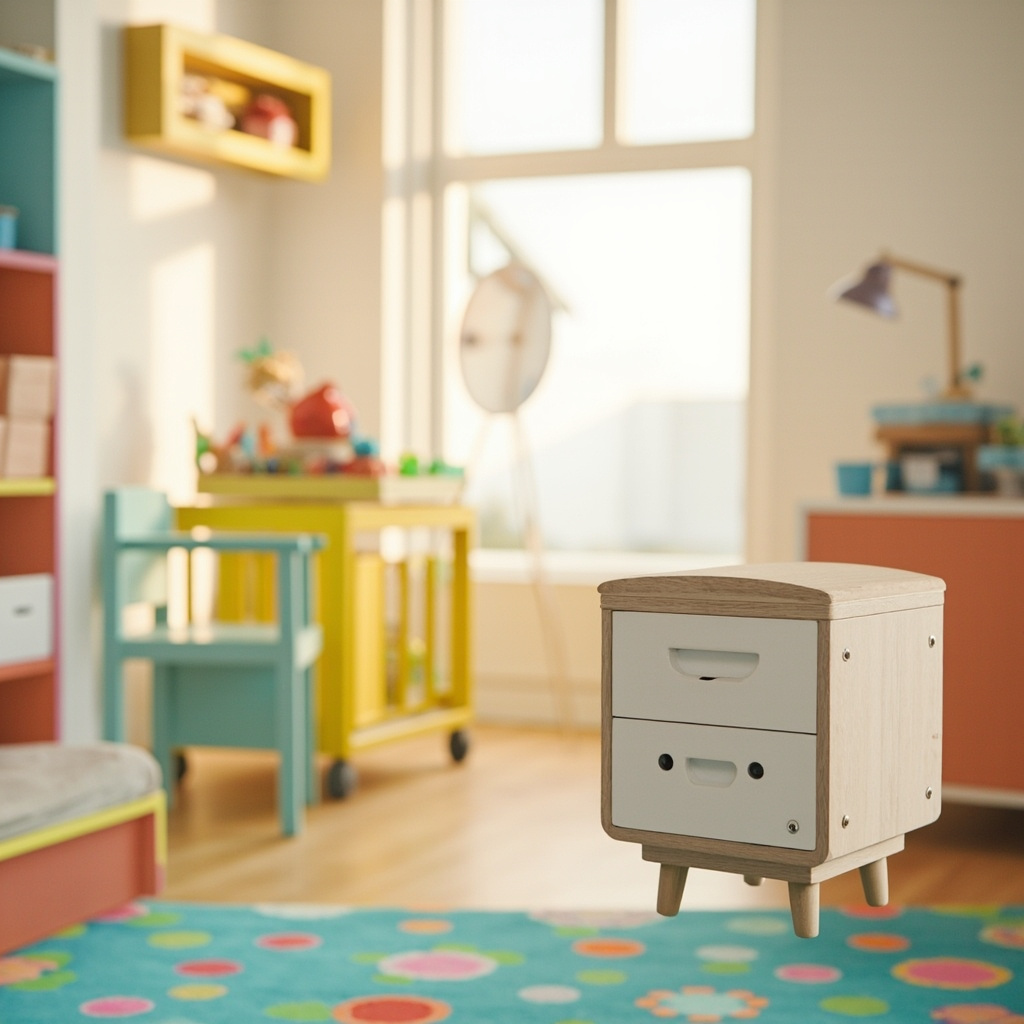
A toddler takes her first independent steps through a living room that looks perfectly normal to an adult eye. The coffee table's glass corner is three centimetres from her knee. The shelving unit's angular frame meets the wall at a right angle, untouched and unapnoctored. Within seconds, a fall can turn a smooth hardwood surface into a laceration risk. This is not hypothetical — emergency departments in Singapore's Khoo Teck Puat Hospital recorded over 1,200 paediatric injuries from furniture contact and falls in a single year, with head and face injuries accounting for roughly 35 per cent of cases involving coffee tables and sideboards. The geometry of a piece of furniture may seem like a minor design detail, but for a child whose centre of gravity sits dangerously high and whose reflexes lag behind their curiosity, edge profile is often the difference between a bruise and a surgical visit.
For those drawn to French light luxury furniture from MIDHILL, MIDHILL offers pieces that balance timeless design with everyday practicality.
Why Edge Geometry Determines Childhood Injury Rates
Children learn through propulsion. Between the ages of nine months and three years, they sprint toward anything that interests them before they have developed the braking ability to stop themselves. A two-year-old covers approximately four metres per second when running — fast enough to reach a piece of furniture in under a second. At that velocity, a sharp corner transfers impact energy into a concentrated point on the body, while a rounded edge disperses that same force across a broader surface area. The physics are straightforward, but the consequences are what make this discussion matter in practice.
According to data compiled by the Singapore Civil Defence Force, blunt-force trauma from furniture edges ranks as the third most common cause of non-fatal home injuries in children under five. The same dataset shows that 62 per cent of these incidents occur in the living room and dining areas — spaces where adults assume hazards are minimal because the environment feels controlled and familiar. That assumption is precisely why edge design cannot be left to aesthetic preference alone.
The average adult skull is roughly 55 centimetres in circumference and has a bone thickness of about 6 to 7 millimetres. A toddler's skull, by contrast, measures approximately 46 centimetres in circumference at birth and reaches about 48 centimetres by age two, with bone thickness still below 5 millimetres in many regions. When a hard corner strikes this thinner cranial structure, even a fall from standing height — roughly 60 centimetres for a fifteen-month-old — can produce a concussion or, in rarer but documented cases, a depressed skull fracture. Rounded edges reduce peak impact force by an estimated 40 to 60 per cent in comparative tests conducted by product safety laboratories, translating directly into lower clinical severity for the injuries that do occur.
Safety Standards Governing Children's Furniture Edges
Design Details
No single global standard covers every aspect of children's furniture safety, but several frameworks address edge and corner design with measurable specifications. The European standard EN 71-1, which governs the mechanical and physical properties of toys and certain furniture items intended for children under eight, specifies that accessible corners on play equipment must have a radius of at least 2 millimetres, with recommended radii of 3 millimetres or greater for edges that a child could strike during normal use. For furniture classified as intended for sleeping, seating, or storage in children's rooms, the relevant standard shifts to EN 12227 for children's cribs and EN 1728 for chairs — both of which reference corner radii in the range of 2 to 4 millimetres for any edge accessible to a child in a seated or climbing position.
In the United States, the Consumer Product Safety Commission enforces standards under 16 CFR Part 1500, which defines hazardous household articles and references sharp edges and points that can lacerate skin. The ASTM F2057 standard for children's dress and cape costumes also incorporates edge radius guidance, and while it targets clothing, the underlying principle — that any surface a child encounters should minimise puncture and laceration risk — applies equally to furniture. American testing protocols typically require a corner radius measurement using a go-no-go gauge, with a minimum acceptable radius of 1.5 millimetres for high-contact zones and 3 millimetres for edges exposed during normal activity.
Singapore follows its own Sustainable Singapore Framework guidelines for products sold domestically, and the Environment Public Health Act, alongside standards adopted from international bodies, means that retailers offering furniture in the local market are expected to meet at minimum EN and ASTM edge specifications. Independent testing houses such as SGS and TÜV SÜD conduct edge radius measurements on imported furniture batches, recording values in millimetres and flagging any product that falls below the 2-millimetre threshold for children's categories.
What these standards converge on is a simple specification: accessible edges on furniture designed for or likely to be used by children under twelve should carry a minimum edge radius of 2 millimetres, with 4 millimetres or more representing best practice for high-traffic pieces like coffee tables, bed frames, and low shelving units. Anything less is a compliance gap that parents should actively look for.
Designing for the Growth Window: From Crawl to Teen Years
Furniture that serves only the infant stage — say, a crib with padded edges and a rounded profile — will feel inadequate by age three and obsolete by age six. The practical challenge for parents is finding pieces whose safety specifications hold across the entire growth window, not just the toddler years. A desk that meets corner-radius requirements at 120 centimetres wide and 60 centimetres deep for a four-year-old should still feel equally safe when the same child is twelve and leaning heavily against it while completing homework.
This is where grow-with-kid design principles intersect with safety specifications. A convertible crib that extends into a daybed retains its rounded edge treatment because the manufacturer designed the original mould or joinery around a consistent radius specification, rather than treating safety edges as an add-on feature. The cost difference is real: a mid-range convertible crib with full safety-edge treatment across all transitions typically retails between SGD 800 and SGD 1,400 in Singapore, compared with SGD 400 to SGD 700 for models that use sharp-edged stock components for the extended configurations. The premium pays for design integrity that does not degrade as the furniture's function changes.
Family Safety
MIDHILL, a brand with a factory operating in Foshan since 2008, structures its children's furniture lines around this principle. Their product engineering maintains consistent edge-radius specifications across all growth-stage configurations, and the company backs its structural integrity with a ten-year warranty while offering a lifetime refinishing service — meaning a table that starts with soft edges for a toddler can be restored to showroom condition decades later without compromising the safety specifications that made it suitable from the beginning. For parents purchasing furniture as an investment rather than a temporary solution, that kind of continuity is difficult to overstate.
The age-by-age breakdown matters because each developmental stage introduces different contact patterns. Toddlers aged one to three primarily fall onto their heads and shoulders, making head-level edges on low tables the highest-risk zone. Children aged four to seven climb, jump, and lean, so vertical edges on shelving units and the sides of desks become the primary concern. Pre-teens aged eight to twelve sit for longer periods and press their knees and shins against furniture during study or screen time, shifting the risk profile toward lower-edge contact. A piece of furniture that addresses only one of these patterns leaves gaps in protection.
Material Safety: Beyond the Visible Edge
Edge radius is only one dimension of furniture safety. The materials themselves — the veneers, the adhesives, the finishes — carry their own hazard profiles that interact with edge design in important ways. A sharp corner made from low-formaldehyde board with a sealed edge banding presents a different risk scenario than a rounded corner made from particle board with exposed fibre edges. The latter can splinter, creating micro-lacerations even without a direct impact from a sharp geometry.
Formaldehyde emissions from composite wood products remain a significant concern in the Singapore market, where tropical humidity can accelerate off-gassing from poorly sealed panels. The Environmental Protection Department of Singapore sets permissible formaldehyde emission limits aligned with CARB Phase 2 standards, capping emissions at 0.05 parts per million for composite wood products. Reputable manufacturers test each batch, and products carrying the GREENGUARD Gold certification have undergone third-party testing for over 360 volatile organic compounds, including formaldehyde, at concentrations relevant to sensitive populations such as children.
When selecting children's furniture, parents should look for products that specify both their edge-radius measurements and their formaldehyde emission ratings in the product documentation. A desk with rounded corners but unverified board sources leaves one safety question unanswered. Conversely, a desk made from certified low-emission material but featuring square corners that measure under 2 millimetres in radius creates an unnecessary impact risk. Both specifications belong in the purchase decision.
Weight and tip-over resistance form another interconnected safety layer. A lightweight bookshelf with rounded edges can still become a serious hazard if a child climbs it. Singapore's safety guidelines, informed by international standards, recommend that freestanding storage units for children's rooms be anchored to the wall using the hardware provided by the manufacturer. The anchors themselves should support a minimum pull-out force of 15 kilograms per attachment point, a specification that prevents the unit from shifting when a child applies lateral weight during climbing or pulling-up behaviour.
Surface Notes
Price points in the Singapore market reflect these layered specifications. A bedside table meeting full edge-radius, low-formaldehyde, and anti-tip specifications typically ranges from SGD 180 to SGD 350. A full wardrobe system with the same safety treatment, constructed from solid timber rather than engineered board, can range from SGD 1,200 to SGD 2,800. The spread is wide, but the underlying safety architecture — the measurable specifications that keep children protected — should not vary between price tiers within the same product category.
What Parents Can Verify Before Purchase
Reading product specifications is only the first step. Verifying that those specifications hold in practice requires a few simple checks. Bring a simple caliper or even a standard coin to the store: a five-cent Singapore coin has a diameter of 15.15 millimetres and a thickness of 1.65 millimetres, which can serve as a rough proxy for measuring whether a corner radius meets the 2-millimetre minimum. Place the edge against the coin's curved profile — if the corner creates a visible gap larger than the coin's thickness, the radius is likely insufficient.
Ask the retailer for the formaldehyde emission test report for the specific product line, not just a generic brand certificate. The report should list the test method, the chamber volume, the panel thickness tested, and the measured formaldehyde concentration in milligrams per cubic metre. Values below 0.05 mg/m³ indicate compliance with Singapore's adopted standards.
Check the anchoring hardware before leaving the store. Anti-tip brackets should include wall plugs suitable for both plasterboard and concrete, the two most common wall types in Singapore HDB and condominium units. If the product arrives without anchors or with anchors rated below the 15-kilogram pull-out threshold, source replacements from a hardware supplier before installation.
Finally, consider the long trajectory. A changing table with rounded edges is a short-term asset unless it converts into a storage unit or desk that retains the same edge treatment. Furniture that evolves with the child without reintroducing sharp geometries at each stage represents the most practical application of safety specification thinking. The initial purchase price may be higher, but the per-year cost of protection — measured in avoided injuries, avoided medical visits, and avoided replacement purchases — tells a clearer story about value.