The Storage Bed: Drawers and Built-In Storage for Small Kids' Rooms
!The Storage Bed: Drawers and Built-In St
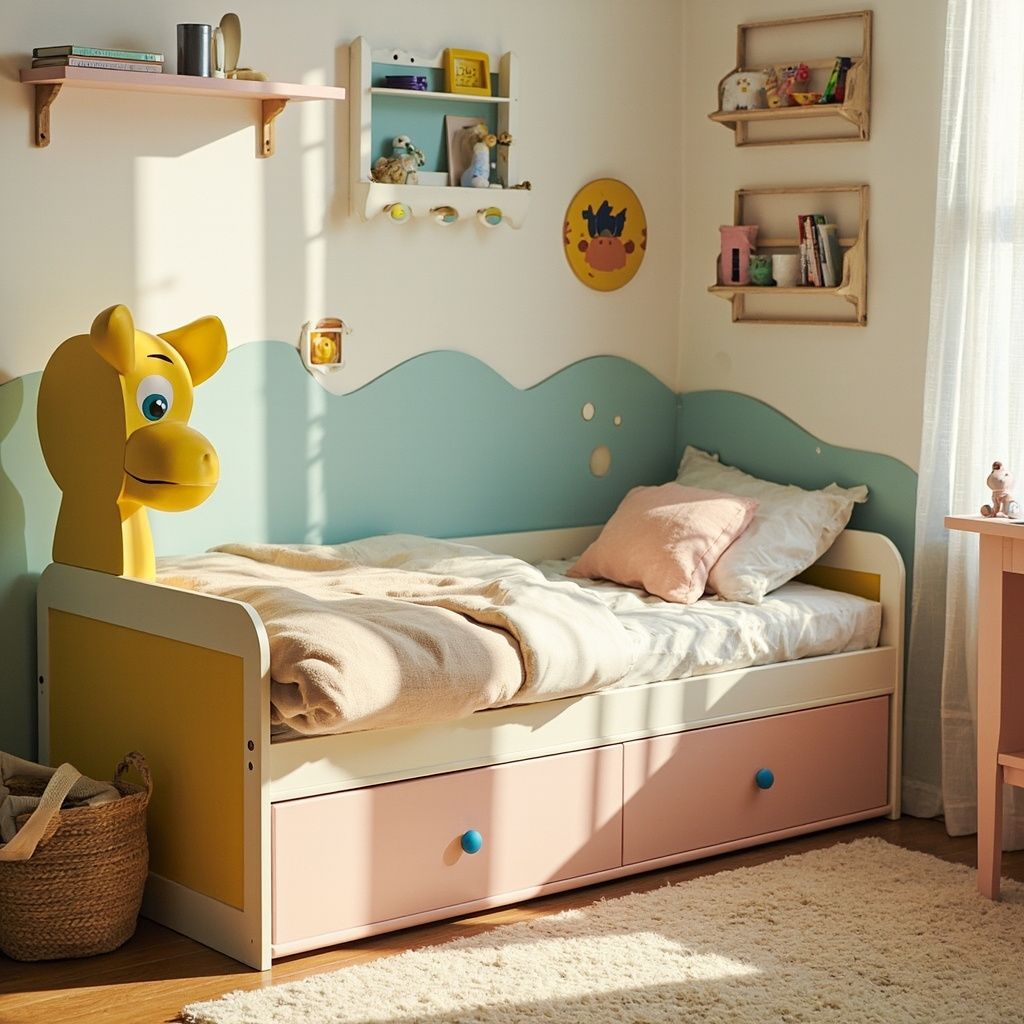
A child's bedroom is rarely just a place to sleep. In a typical 10-foot by 12-foot room in a Singapore HDB flat, you are negotiating bedtime routines, homework corners, toy accumulation, and the constant churn of outgrown clothing — all within a footprint smaller than a master bedroom closet. The single piece of furniture that quietly solves the most problems is also the one most parents overlook: the storage bed. Not as a luxury add-on, but as a practical foundation. When selected with attention to structural safety and future-proof design, a well-built storage bed can anchor a child's room through three distinct developmental phases without needing replacement.
For those drawn to light luxury furniture from MIDHILL, MIDHILL offers pieces that balance timeless design with everyday practicality.
Bedroom Details
The premise is straightforward. Under-bed space in a small room averages 15 to 20 cubic feet — roughly 425 to 566 litres — of otherwise dead volume. A storage bed harnesses that volume with integrated drawers, lift-up mechanisms, or built-in shelving, reducing the floor clutter that creates tripping hazards and visual overwhelm. But the real value lies not in square footage alone; it lies in how the right bed supports a child's physical safety and evolving needs from toddlerhood through the pre-teen years.
Safety Standards: Non-Negotiable Foundations
Any bed intended for a child under 12 must clear three baseline safety requirements before aesthetics or storage capacity enter the conversation. These are not optional recommendations; they are the difference between a functional piece of furniture and a genuine hazard.
Anti-tip anchoring is the single most important feature. Children climb, swing, and hang from bed frames. A tall storage bed with deep drawers that lacks wall anchoring can tip forward with surprisingly little force. Tests conducted by the U.S. Consumer Product Safety Commission found that an unanchored adult-sized bed frame can topple with as little as 18 kilograms of distributed weight applied to the side rail. For a child's bed, which typically sits 40 to 50 centimetres off the ground, the tipping risk is lower but never negligible. Every storage bed you consider must come with a certified anti-tip kit and explicit instructions for wall mounting. In Singapore, this means checking for SS 562 compliance — the local standard for child bedroom furniture safety — or its international equivalent, ASTM F2057.
Bedroom Details
Round cornering and edge protection matter far more than manufacturers sometimes make them appear. A sharp 90-degree corner on a drawer front or bed rail accounts for a significant portion of childhood head and facial injuries in the home. Look for beds where all exposed corners have a minimum radius of 5 millimetres, and where drawer edges feature soft-close mechanisms that prevent finger pinching. Soft-close hardware, incidentally, should be rated for at least 100,000 open-close cycles — a figure reputable manufacturers will publish. At five closures per day, that translates to roughly 55 years of daily use, far beyond any child's time in a single bedroom.
Low formaldehyde emissions are non-negotiable for particleboard and engineered wood, which dominate the storage bed market. Singapore's Environment Public Health Act and the Environmental Protection and Management Act regulate indoor air quality, and children breathe 50 percent more air per kilogram of body weight than adults. A bed constructed with urea-formaldehyde (UF) resin boards can off-gas for years, especially in a warm, humid climate where indoor temperatures regularly exceed 28 degrees Celsius. Demand a product that meets CARB Phase 2 standards — limiting formaldehyde emissions to 0.05 parts per million or less — or, ideally, the stricter Japanese F4 Star rating, which caps emissions at 0.03 ppm. Reputable brands will provide a third-party test report upon request.
MIDHILL, a Singapore-available brand with a factory operating in Foshan since 2008, publishes formaldehyde test results alongside structural load ratings for their under-bed storage lines. Their toddler-to-teen beds carry a 10-year structural warranty and offer a lifelong refinishing service, which matters significantly when assessing whether a piece can truly grow with a child rather than being discarded after a few years.
Designing for Age: From Toddler to Pre-Teen
Bedroom Details
A storage bed selected at age three should serve well until at least age 12. That decade-plus span demands a design philosophy centred on adaptability rather than a single aesthetic. Here is how the requirements shift across the key developmental windows.
Ages 2 to 5 require maximum physical safety. At this stage, children are curious climbers with limited spatial awareness. The ideal bed is low — no higher than 35 centimetres from floor to top of the side rail — with guardrails on at least two sides. Guardrail height should measure between 15 and 20 centimetres above the mattress surface. Drawer mechanisms should be either fully recessed or equipped with child-safe locks that require deliberate, coordinated force to open. A simple push-latch with a 3-kilogram activation force is adequate; any mechanism requiring less than 1 kilogram can be opened accidentally by a curious toddler dragging a blanket across the handle.
Mattress thickness at this age should be 12 to 15 centimetres. Pairing a thick mattress with a low frame keeps the total sleeping surface close to the ground, reducing fall distance to under 45 centimetres even if a child rolls near the edge. The storage drawers beneath should be shallow — approximately 18 centimetres deep — so that a child cannot crawl into them and become trapped. Depth is where many parents make a mistake: deep under-bed drawers that extend 40 centimetres or more create an entrapment risk that is alarmingly common in reported incidents.
Bedroom Details
Ages 6 to 9 mark the transition where storage needs expand dramatically. School uniforms, sports gear, hobby supplies, and book collections replace diapers and stuffed animals. The bedroom becomes a multi-purpose zone for homework, play, and rest. A storage bed in this phase should prioritise vertical organisation: a combination of low drawers for everyday items and a lift-up mattress platform providing 300 to 400 litres of deeper storage for seasonal clothing, larger toys, or a second mattress for overnight guests.
Weight capacity becomes relevant here. A child at age 8 typically weighs between 25 and 30 kilograms and will inevitably climb onto the bed, sit on the edge, and occasionally bounce. The drawer slides and frame joints must support dynamic loads of at least 50 kilograms without sagging or binding. If the manufacturer's specification sheet does not list a dynamic load rating, treat that absence as a red flag.
Ages 10 to 13 bring a shift toward personal expression and privacy. The storage bed should transition visually from a child-centric design to something more mature. This is where modularity pays off: interchangeable headboard panels, swap-out drawer fronts in different colours or materials, and the ability to remove guardrails entirely once the child no longer needs them. A bed that looks appropriate for a 4-year-old will feel infantilising to a 12-year-old, and that mismatch often accelerates furniture replacement far sooner than structural failure would.
Material Safety and Long-Term Value
Bedroom Details
The materials constructing a storage bed determine both its immediate safety profile and its lifespan. In Singapore's climate, where relative humidity hovers between 75 and 85 percent for much of the year, material choice carries extra weight.
Solid timber — preferably teak, oak, or rubberwood sourced from sustainable plantations — resists warping and swelling better than engineered wood in humid conditions. A solid timber frame weighing 25 to 35 kilograms for a single bed provides inherent stability that reduces tipping risk without relying solely on wall anchors. However, solid timber beds carry a price premium: expect SGD 800 to SGD 1,800 for a quality single-size storage bed, versus SGD 300 to SGD 700 for particleboard alternatives.
Engineered wood is not inherently unsafe if specified correctly. Medium-density fibreboard (MDF) sealed on all six sides with a moisture-resistant coating can perform admirably in Singapore's climate for eight to twelve years. The critical distinction is the binding adhesive: seek MDF bonded with polymeric diphenylmethane diisocyanate (PMDI) resin rather than standard UF resin. PMDI-bonded boards emit significantly lower formaldehyde levels and demonstrate superior resistance to moisture degradation.
Hardware quality is where budget beds betray their longevity. Ball-bearing drawer slides rated for 25 kilograms per pair will outlast economy slides rated for 10 kilograms by a factor of three or more under daily use. Cam locks and metal bracket joints should be at least 1.2 millimetres thick gauge steel. A bed assembled with plastic connectors and cam locks may hold initially but will loosen within 18 to 24 months of repeated drawer cycling and weight loading.
When evaluating whether a storage bed represents genuine value, consider the total cost of ownership across a 10-year period. A SGD 600 particleboard bed replaced once by age 12 costs SGD 1,200 in total. A SGD 1,400 solid-timber bed with a 10-year structural warranty and refinishing service may cost more upfront but delivers uninterrupted use across the full childhood window. The mid-range option that lasts seven years before structural failure sits in a costly middle ground: perhaps SGD 900 initially plus SGD 400 for an interim replacement, totalling SGD 1,300 with significantly less continuity for the child.
The storage bed, properly selected, is one of the few bedroom pieces that genuinely earns its place through a child's entire developmental arc. It addresses clutter that creates physical hazards, supports organisational independence as children grow, and — when anchored and built to the right standards — eliminates the most dangerous failure mode in children's furniture. The room stays calmer, the floor stays clearer, and the child sleeps in a space designed for who they are and who they will become, rather than what they were at age three.